The state is one of the largest “service providers”, with many millions of customers, so even small efficiency gains can produce substantial cost reductions and improvements in service quality. Large volumes of structured data underpin government operations, creating an ideal foundation for AI-based systems. Countries leading innovation in government operations have been testing and gradually introducing various artificial intelligence systems for years. The direct benefits are diverse: more effective tax collection, fraud detection, internal knowledge management, automated customer service and reduced administrative workload, for example.
According to an analysis by the UK government and consulting firm Bain, AI and digitalisation could deliver £45 billion in annual savings in the future. Most would come from automating administration, with smaller contributions from fraud reduction and digital public services. In a trial involving 20,000 people, civil servants saved 26 minutes per day, equivalent to about two working weeks per year. The UK government handles 143 million complex cases annually, 84% of which can be automated: saving just one minute per case would save 1,200 person-years of work each year. According to McKinsey, as many as 80% of government administrative processes can be partially automated, representing at least 30% potential cost reduction.
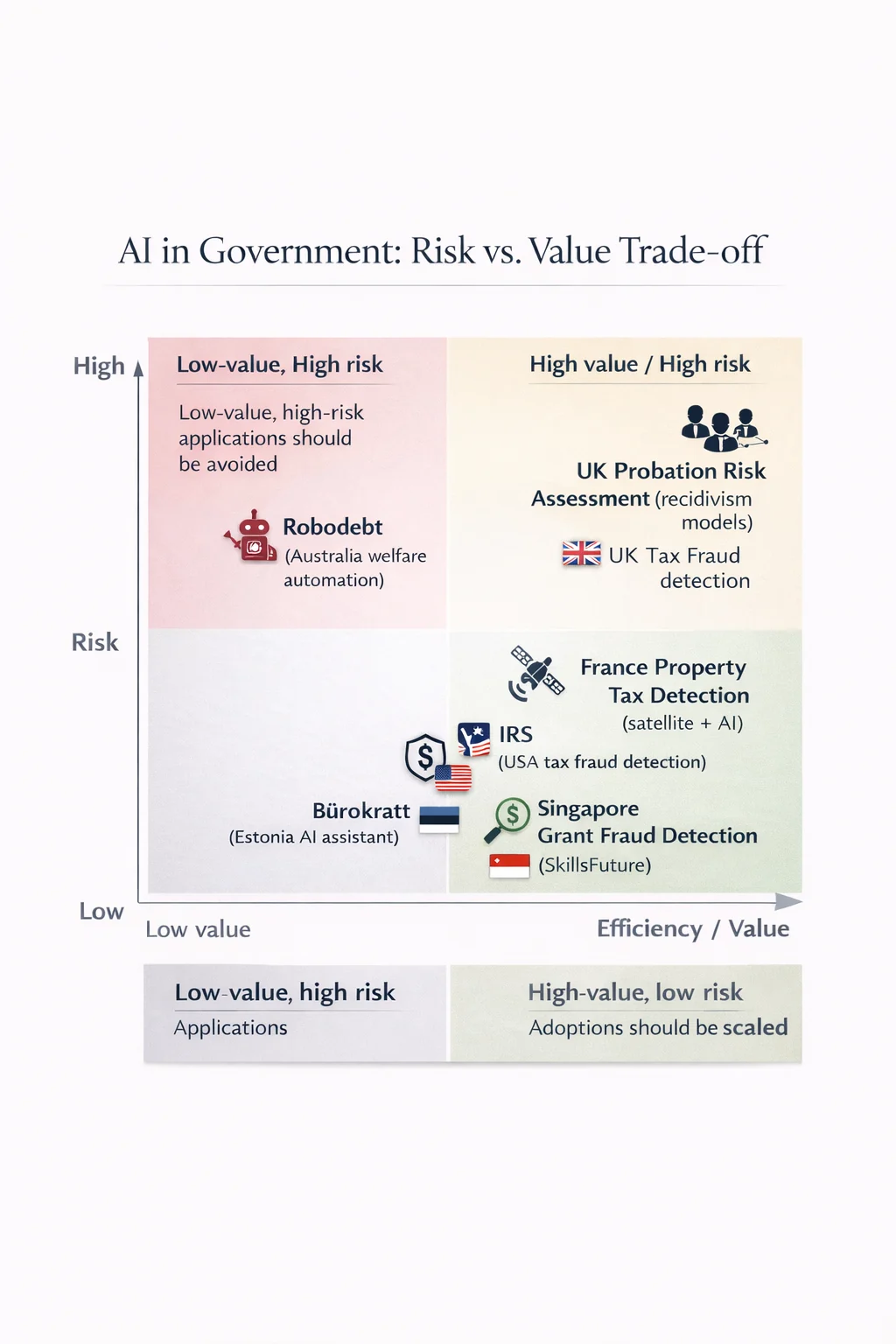
In France, the tax authority uses AI to detect property tax evasion by analysing satellite imagery. The system identified tens of thousands of undeclared properties, directly increasing tax revenue. Around 2020, the UK Ministry of Justice began introducing AI-based speech recognition and text analysis for court records. In 2022, the UK Department for Education launched the Year 4 Literacy Proof of Concept project, using AI to assess and develop reading skills. The system analyses students’ responses through natural language processing and provides personalised feedback. The aim was to reduce educational inequality and teachers’ administrative burden. Initial results suggest that AI provides scalable support, although it does not replace educational decision-making. Singapore introduced AI-based fraud detection in government training subsidies around 2019. The system looks for patterns in payments and can identify suspicious transactions, significantly reducing abuse. This approach illustrates that AI is particularly strong where large volumes of structured data are available.
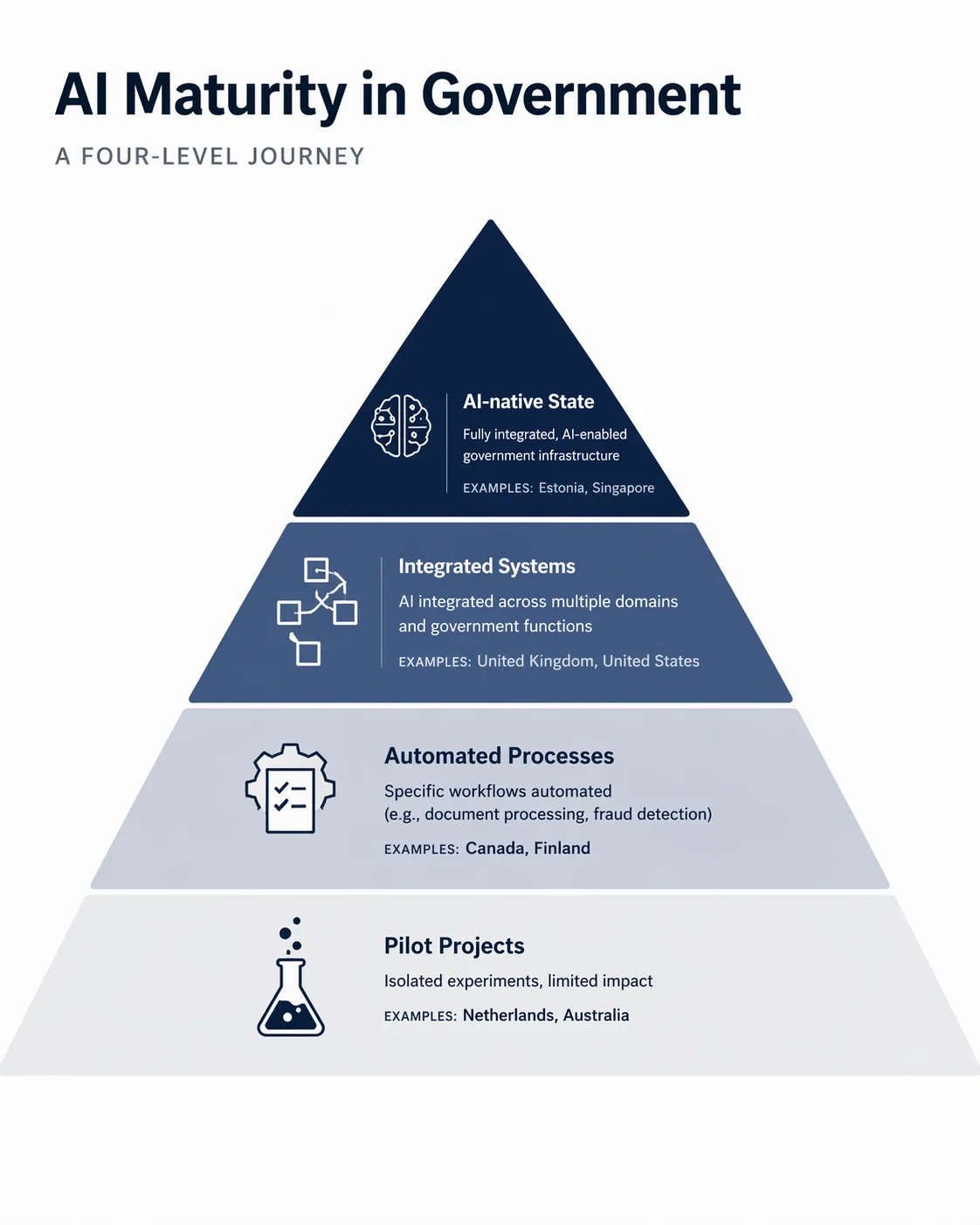
A growing number of countries, including the United Kingdom, the United States and Singapore, are building entire government AI infrastructures rather than isolated projects. This includes developing internal chatbots and integrating generative AI systems into public administration. In 2019, Estonia launched Bürokratt, a state-run, multichannel AI virtual assistant service. The aim was to create a unified interface for citizens to access e-government systems. Experience has been positive, with high usage and a strong international reference.
Most challenges in government AI are matters of governance and management, rather than technology. Almost nowhere is the main question whether to introduce AI, but who is responsible, when human oversight is mandatory, what must be published about it, what data it may use, how to avoid dependence on a single supplier or platform, and whether AI is treated as a project or as core infrastructure. The United States seeks to control risk and avoid supplier dependence through strong central rules alongside decentralised operations. The United Kingdom tests with pilots and then scales, which is fast but can easily lead to fragmented systems. Singapore, by contrast, uses a unified platform approach in which AI development and procurement form part of a closely integrated strategy.
Introducing AI into government is not a one-off project but a long journey - an iterative learning process in which early mistakes and failures are inevitable because technology changes and organisational operations must be transformed. States that do not begin this learning curve now will face a structural disadvantage later, lacking both operational experience and appropriate institutional competence. Early mistakes cost less than delay: AI’s value is maximised when an organisation can gradually adapt to it.
Zsigmond Varga
Key government AI strategies:
OECD - Governing with Artificial Intelligence (2021)
This document provides an international framework for government AI use, with particular emphasis on decision support, automation and accountability. Its core message is that AI is not simply an efficiency tool, but a governance issue requiring institutional oversight and ethical rules. https://www.oecd.org/en/publications/governing-with-artificial-intelligence_795de142-en.html
European Union - AI Act (2024)
The AI Act is the first comprehensive risk-based regulatory system, classifying AI applications into categories with different compliance obligations. Its purpose is to place AI development and use within a safe, transparent and legally controlled framework.
USA - OMB M-25-21 (2025)
This guidance sets out how federal agencies should introduce AI to improve public services while preserving legal and privacy safeguards. Human oversight, risk management and the accountability of AI systems are key elements.
United Kingdom - AI Playbook for the UK Government (2023)
This practical handbook provides specific steps for planning, developing and implementing government AI projects. It emphasises that AI should be treated as a solution to business and service problems, rather than as a technological experiment.
United Kingdom - AI Exemplars Programme
Specific use cases: courts, healthcare and education.
Singapore - National AI Strategy 2.0 (2023)
This strategy positions AI not only as a technology tool, but as an instrument of national economic development and state building, with application plans broken down by sector. The focus is on implementation, talent development and building government AI infrastructure, rather than merely theoretical principles. https://www.smartnation.gov.sg/initiatives/national-ai-strategy/